
PV module frame sourcing
Solar Panel Frame Profile
A Solar Panel Frame Profile forms the perimeter of a photovoltaic module, bringing the laminate edge, corner connection and mounting interface into one design. Compare published reference sections, work through a finished-member quantity example and check assembly fit before sending Aluminum Profile Works your drawing for supply review and a quote.
Check the frame interfaces before quoting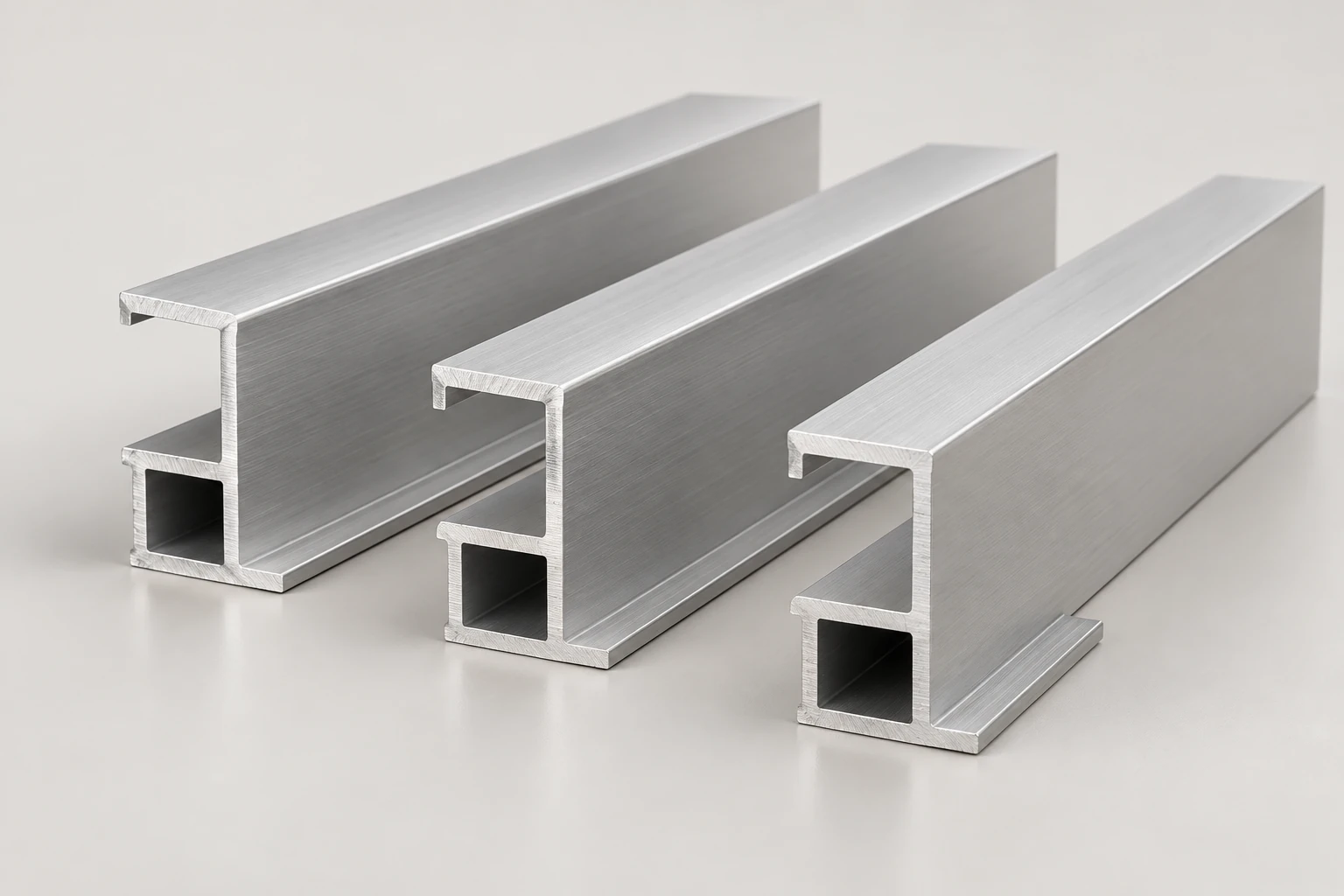
An open receiving groove sits above a closed connection cavity and lower flange.
Build the profile around the module interfaces
Aluminum extrusion allows frame features to be integrated into a continuous section. Hydro describes both photovoltaic module frames and separate mounting systems, with different frame designs and finishes. Select the geometry for your assembly rather than treating all solar extrusions as interchangeable. [1]
A defined laminate-edge interface
Identify the receiving groove, supporting shelf and edge clearance on the section drawing. These details let the module designer review the fit with the laminate and the specified sealing system.
A matched corner connection
Review the long and short frame members together with the corner key or other joining detail. The internal cavity, end preparation and connection method need to match as an assembly.
A clear mounting interface
Identify the flange, fixing features and permitted contact faces in the module design. Give the sourcing team the relevant drawing details without assuming that a common overall height establishes compatibility.
Solar Panel Frame Profile product information
- Profile category
- Solar Panel Frame Profiles
- Product family
- PV module perimeter frame extrusions
- Section specification
- Drawing-defined glass channel, corner-key cavity and mounting flange; confirm dimensions and cut lengths by inquiry
- Supply specification
- Agree the applicable product standard and tolerances in the RFQ
Solar Panel Frame Profile reference sections
Compare two published frame families from Zhonghao. Each family uses different long-side and short-side sections, even though their overall heights match. The source calls the receiving feature "slot size"; that label alone does not establish the allowable laminate thickness. [3] [4]
| Published section detail | 30 mm long side [3] | 30 mm short side [3] | 35 mm long side [4] | 35 mm short side [4] |
|---|---|---|---|---|
| Overall height (mm) | 30 | 30 | 35 | 35 |
| Source section size (mm) | 30 × 32 | 30 × 18 | 35 × 35 | 35 × 24.5 |
| Source "slot size" (mm) | 6.1 | 6.1 | 4.9 | 4.9 |
| Frame member | Long side | Short side | Long side | Short side |
These third-party sections support comparison, not APW stock or confirmed supply. Wall thickness, corner-key cavity dimensions and linear mass are not specified in this table. Match the full section and mating parts to the approved module drawing; a shared height or slot label does not establish interchangeability.
Profile geometry
Solar Panel Frame Profile views and section
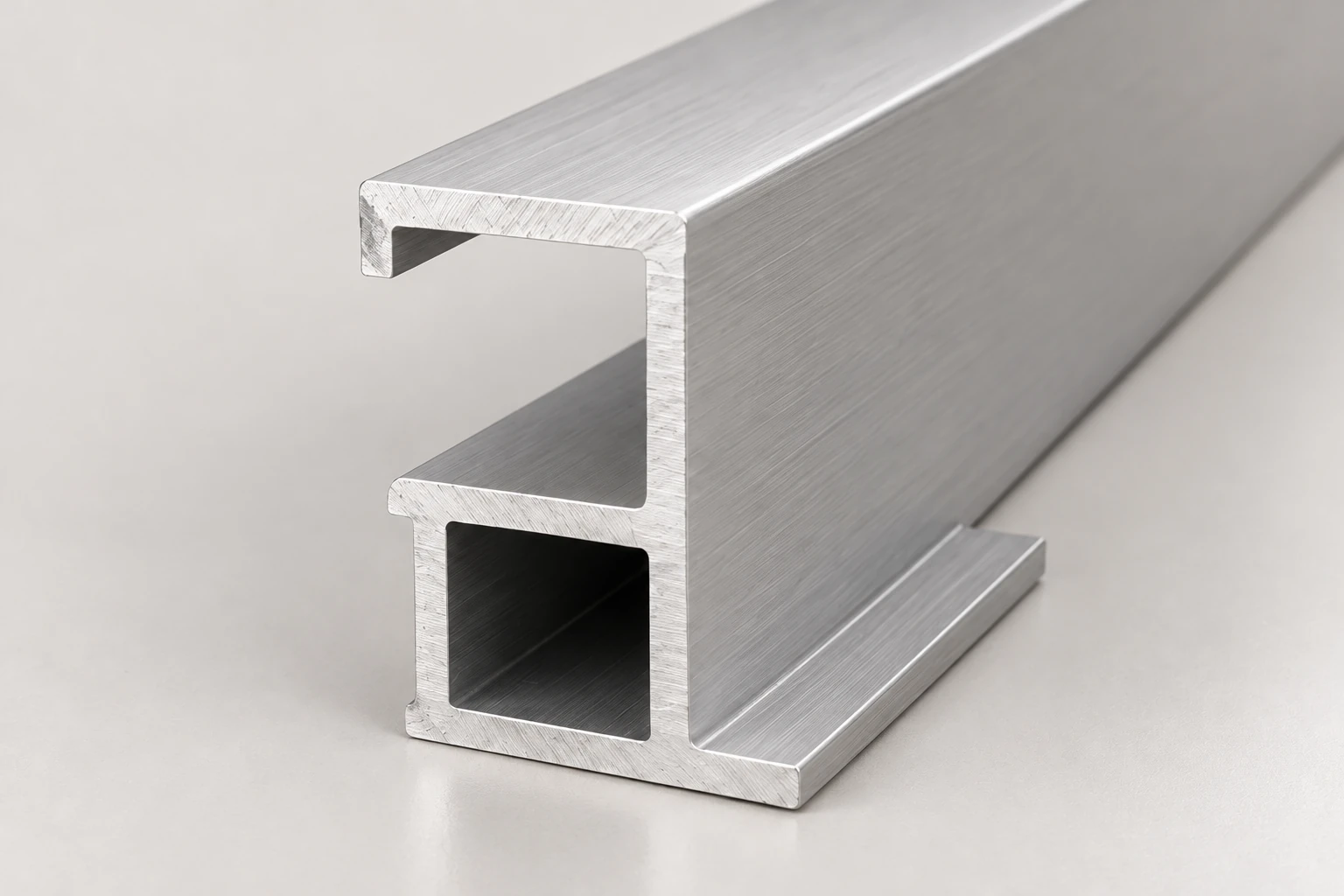
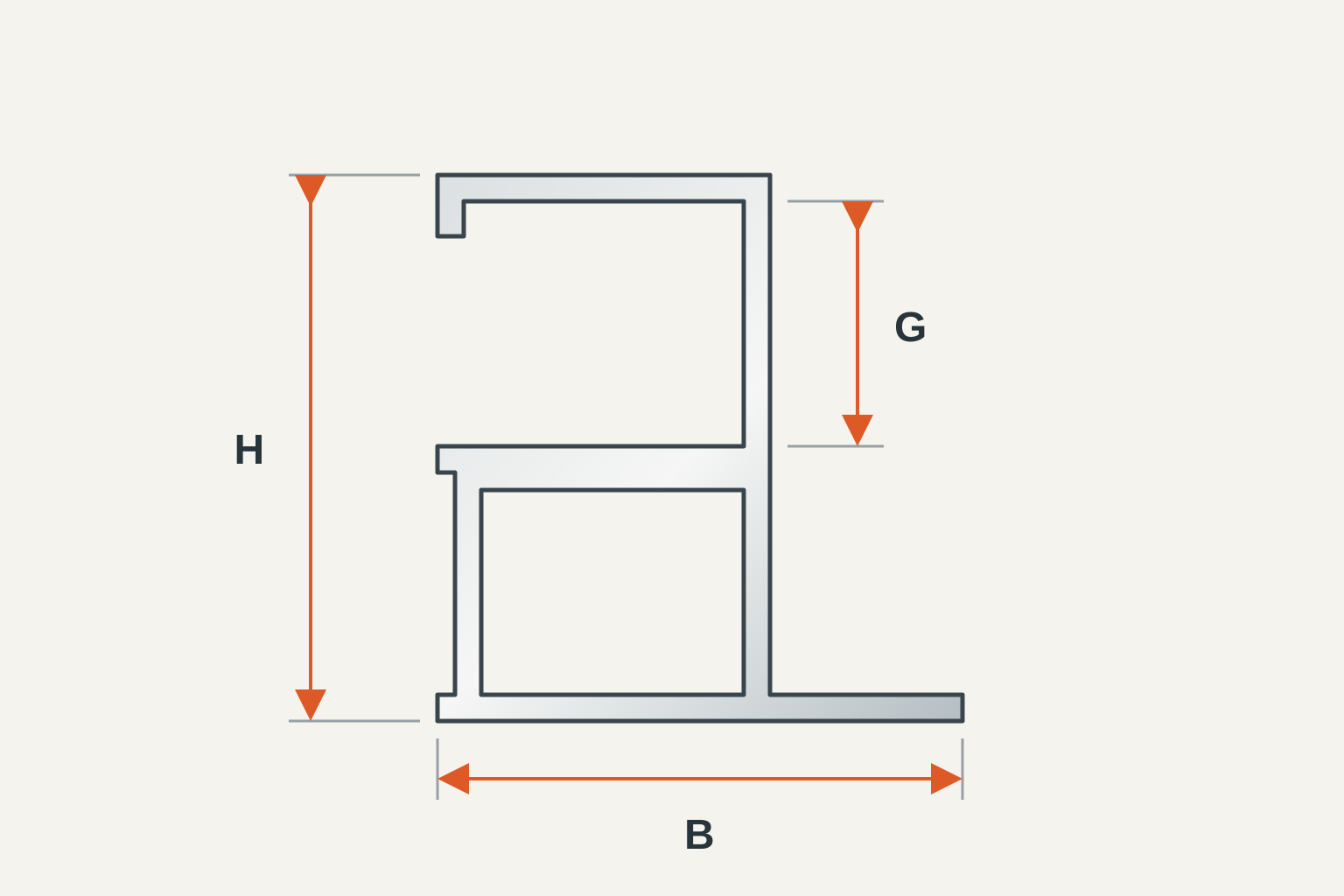
The renderings explain one perimeter-frame form. Confirm the selected cross-section, corner connection and dimensions on the approved order drawing.
Solar Panel Frame Profile finished-member quantity example
Start with an agreed cut list so quantities in pieces, sets and metres can be compared. This independent worked example starts from specified finished-member lengths; it is not derived from either reference module above.
- The order example contains 1,000 sets, with two long and two short members per set.
- Both member lengths are finished outside-tip-to-outside-tip lengths for the assumed mitred ends. Define that datum on the order drawing; do not substitute the glass size or module outline.
- The totals cover finished members only. Saw kerf, end trimming and nesting losses require a separate raw-stock calculation.
| Frame member | Pieces per set | Finished length per piece (mm) | Pieces for 1,000 sets | Finished net length (m) |
|---|---|---|---|---|
| Long side | 2 | 2,000 | 2,000 | 4,000 |
| Short side | 2 | 1,100 | 2,000 | 2,200 |
Each set contains 6.20 m of finished members. The order contains 4,000 pieces and 6,200 m in total: 4,000 m of long-side members plus 2,200 m of short-side members. Do not apply a default waste percentage or infer raw-stock lengths from this net total.
Finished net length (m) = sets × (2 × long finished length in mm + 2 × short finished length in mm) ÷ 1,000. For this example: 1,000 × (2 × 2,000 + 2 × 1,100) ÷ 1,000 = 6,200 m. Finished mass (kg) = long-side net length (m) × long-side linear mass (kg/m) + short-side net length (m) × short-side linear mass (kg/m).
Send your frame drawings and member quantitiesSolar Panel Frame Profile assembly checks
Use an observed fit-up problem to organize measurements and feedback. The following are possible checks, not a unique diagnosis; compare the findings with the approved part and assembly drawings.
| Observed symptom | Possible contributors | Checks and feedback to provide |
|---|---|---|
| Corner key is difficult to insert | Cavity/key fit, internal radii, burrs or dimensions after surface treatment | Measure the key and cavity at the affected location; record the finish condition, insertion position and end-view photographs. |
| Corner gaps are uneven | Finished-length datums, cut angles, end-face condition or locating position | Provide the specified and measured member lengths, cut-angle checks and photographs of each assembled corner. |
| The two frame diagonals differ | Member lengths, joint positioning or assembly-fixture alignment | Record both diagonals, all member lengths, joint seating and the fixture setup used for measurement. |
| Laminate edge binds or feels loose | Complete edge-stack thickness, groove geometry, sealing system or assembly allowance | Compare the full laminate edge and groove dimensions with the approved sealing detail; identify where contact or excess clearance occurs. |
| Mounting contact is uneven | Contact-face geometry, frame distortion or mismatch with the mating fixture | Record the contact locations and relevant section and fixture dimensions. Review the mating drawings and module requirements. |
Agree tolerances and acceptance criteria for the selected assembly. These checks do not prescribe a corrective machining operation, a clamp torque or a module load rating.
Frame profile or solar mounting rail?
A Solar Panel Frame Profile and a mounting rail perform different jobs. Hydro identifies module frames and module mounting systems as separate photovoltaic applications. Start with the part's position in your assembly. [1]
- Perimeter frame: surrounds the module edge. Specify the laminate interface, long and short members, corner connection and mounting faces.
- Mounting rail: belongs to the supporting assembly beneath or behind the module. Its clamp channel, splice and support interfaces require a separate rail specification.
- Compatibility: a matching nominal height does not establish a fit. Review the actual frame contact faces and connection details with the relevant module and mounting drawings.
Match the frame requirement to the module build
The Solar Panel Frame Profile inquiry should identify the module construction and the stage at which you need the members supplied. Single-glass and double-glass frame families appear separately in the manufacturer reference catalog. [2]
- Glass-backsheet module frames
Provide the complete laminate edge construction, section drawing and sealing detail for the intended module. Confirm the receiving interface rather than selecting from the front-glass thickness alone.
- Double-glass module frames
Identify both glass layers and the complete edge stack in the drawing. State the required groove, edge clearance and assembly allowances for that particular design.
- OEM frame-member sourcing
Separate requirements for extrusion lengths, finished members and matched frame sets. List any requested cutting, holes, corner keys and identification so their feasibility and supply scope can be reviewed.
Prepare a drawing-led sourcing request
Send the section and assembly drawings with revisions, quantities by member and destination. Specify alloy, temper, product standard, inspection documents and packing. For the requested finish, identify color, coating requirements, exposed faces and the appearance reference. Mark cut angles, hole locations, datums and burr limits. APW reviews the selected Solar Panel Frame Profile and the requested supply scope before quotation.
Check the interfaces before selecting a section
Review the Solar Panel Frame Profile as part of the complete module frame. Resolve these three interfaces before freezing the purchasing drawing.
Laminate and seal
Dimension the receiving groove and identify the laminate stack, seating position, sealant or gasket requirement and assembly clearance. Have the module designer approve the fit.
Long and short members
Provide both member drawings, finished-length datums, end angles and the required frame outline. State whether each quantity means individual lengths or complete sets.
Mounting and functional openings
Identify the mounting faces and any drainage, fixing or bonding features on the approved drawing. Review the applicable module documentation; carry the critical dimensions, tolerances and mating-part references into the RFQ.
Match the corner key to the frame cavity
A cavity outline alone does not define a complete connection. Include the joining component and its assembly requirements in the inquiry.
Mating dimensions
Supply the corner-key drawing or mating-part specification, insertion depth, cavity tolerances and relevant radii. State any required clearance or interference fit explicitly.
Assembly method
Identify the proposed joining method, locating features and inspection criteria. Request feasibility review for cutting or machining; these operations are not implied by the product-family name.
Solar Panel Frame Profile RFQ example
Combine the selected drawing details with the member quantities. Distinguish individual pieces from complete sets, and state the finished-length measurement datum.
- Product and drawings
- PV module perimeter frame; attach section, long-member, short-member and assembly drawings with revisions
- Module interface
- Provide laminate construction, edge thickness, groove dimensions and sealing requirements
- Material and appearance
- State required alloy, temper, finish, exposed faces and applicable acceptance documents
- Connection and processing
- Attach corner-key details; identify cut lengths, end angles, functional holes and tolerances
- Quantity and delivery
- List quantities per member or complete set, sample requirements, packing and destination
Request confirmation of the quoted supply scope, tooling, samples and inspection requirements before placing the order.
Send your frame profile requirementAgree the acceptance checks before ordering
Define measurable checks for the selected drawing and assembly. Agree sampling and documentation with the supplier during quotation.
Section and finished-member geometry
Identify critical groove and cavity dimensions, wall thicknesses, length, end angle, hole positions, straightness and twist limits, including measurement datums.
Appearance and traceability
Agree the finish reference, permissible marks on visible faces, burr condition, member identification, protective packing and required material or inspection records.
Assembly verification
Check the selected members with their mating parts against the approved assembly criteria. A dimensional inspection of the extrusion alone does not establish the complete module's load rating or certification.
Frame design and application references
Use these first-party sources to understand the product category and the variation between frame designs. Their product specifications do not establish APW availability.
- [1] Hydro: Aluminium in photovoltaicsDistinguishes module frames from mounting systems and describes extrusion-based frame designs and finishes.
- [2] Zhonghao: Solar frame product catalogShows separate single-glass, double-glass and custom-frame families. Refer to individual drawings for each manufacturer's dimensions.
- [3] Zhonghao: 30 × 32 / 30 × 18 frame membersPublished long-side and short-side section sizes, 30 mm overall height and 6.1 mm source slot-size specification.
- [4] Zhonghao: 35 × 35 / 35 × 24.5 frame membersPublished long-side and short-side section sizes, 35 mm overall height and 4.9 mm source slot-size specification.
Solar Panel Frame Profile questions
What is a Solar Panel Frame Profile?
It is an extruded section used to form a photovoltaic module's perimeter frame. The selected design defines the laminate-edge interface, corner connection and mounting features. It is a component specification rather than a complete mounting system.
Does frame height determine which profile I need?
No. Overall height is only one dimension. Check the groove opening and depth, laminate edge, wall thicknesses, corner-key cavity, flange and complete assembly drawing. Different sections can share an overall height without being interchangeable.
Which alloy, temper and finish can I request?
State the material and finish required by your approved design, including appearance and documentation requirements. APW reviews these with the selected section and quantity; this product-family listing does not confirm a particular alloy, temper or finishing service.
Can the same section fit single-glass and double-glass modules?
Do not assume a shared section fits both. The complete laminate stack, groove geometry and sealing arrangement need to match. Manufacturer catalogs distinguish these frame families; use the module designer's drawings to select the actual interface. [2]
Are corner keys and finished frame sets included?
List them explicitly in the inquiry. Extrusion lengths, processed long and short members, corner keys and complete sets are different supply scopes. The quotation should confirm which components and operations are included.
Does a Solar Panel Frame Profile have a universal load rating?
No. Section dimensions and material alone do not establish the performance of an assembled module. The module designer must assess the complete design, connections, mounting conditions and applicable verification requirements. No load rating or module certification is claimed for this product family.
What should I send to obtain a quote?
Send the current section and assembly drawings, required material and finish, finished lengths, quantities and destination. Include corner details, requested processing, tolerances, inspection records and packing requirements so the supply scope can be reviewed.
Is finished net length the same as the raw material to order?
No. The Solar Panel Frame Profile example totals 6.20 m per set and 6,200 m for 1,000 sets of finished members. Raw-stock purchasing also depends on available stock lengths, saw kerf, end trimming and the cutting layout. Long-side and short-side linear masses must be known separately before calculating weight.
Specify your Solar Panel Frame Profile for quotation
Compare the reference sections, prepare your member quantities and resolve the key fit-up questions. Send APW the selected Solar Panel Frame Profile drawings, material and finish requirements, and destination for supply review.
Browse profiles